
THE CREDIT MASTERY BOOK SERIES
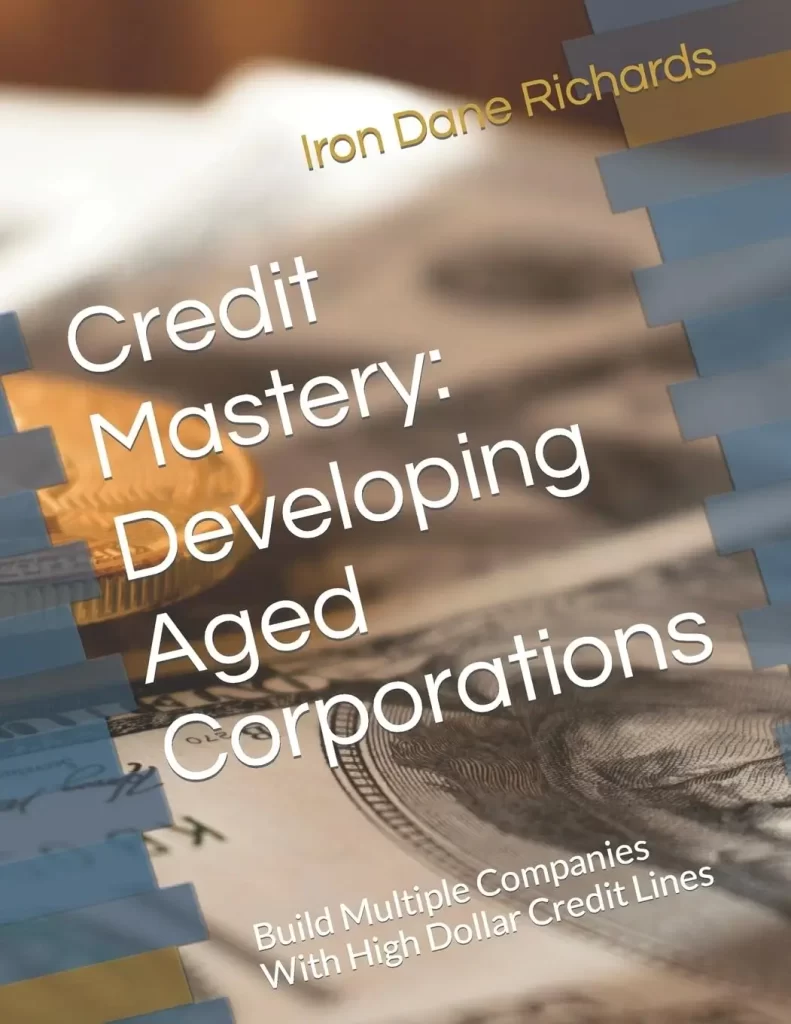
Credit Mastery: Developing Aged Corporations
A field manual for structuring multiple business entities and building each one’s reportable credit history — written by Iron Dane Richards, creator of the Credit Mastery System.
Iron Dane Richards — Author | ISBN 978-1505876314 — Paperback | Multiple printings — periodically updated
WHAT THE BOOK IS
A structured approach to building business credit across more than one company
Credit Mastery: Developing Aged Corporations is a business-credit reference manual, not a quick-tip article. It walks a reader through choosing a legal structure and state of formation, understanding how company age and filing history factor into a credit profile, and then methodically opening the vendor, trade, and bank accounts that build a Dun & Bradstreet file over time.
Rather than covering one company in isolation, the book is built around running several entities at once — each at a different stage of its own credit-building timeline — with a companion workbook for drafting the business plan that lenders will want to see.
The material is organized as a reference you return to at each stage: formation, initial file setup, account building, and funding, followed by an advanced section on scaling the strategy across multiple companies.
3–9 months
Typical roadmap laid out in the book, from entity setup to a matured credit file
$250K–$1M
Funding range the publisher frames as the system’s target outcome per company
2015–present
First published via CreateSpace; periodically revised with updated lender information
WHO REACHES FOR THIS BOOK
Built for owners who plan to build credit more than once
Founders launching a new entity
Readers deciding where and how to form a company who want the credit-building sequence mapped out from day one, rather than learned by trial and error.
Owners running several companies
Business owners who want a repeatable process for standing up multiple entities and tracking each one’s credit file, funding sources, and reporting status side by side.
Anyone preparing for funding
Readers who need a business plan and supporting documentation ready for lenders and want a workbook structure rather than a blank page.
INSIDE THE MANUAL
How the material is organized
The book moves through five broad stages. Chapter names and exact order vary slightly by printing, but the progression stays consistent across editions.
01
Entity Structure & Formation
Comparing legal entity types and weighing where to form a company, including commonly used states such as Nevada, Wyoming, New Mexico, Colorado, and South Dakota.
- Business structure options and trade-offs
- State-by-state formation considerations
- Evaluating pre-existing (shelf) companies before purchase
02
Opening the Credit File
Setting up a company’s initial Dun & Bradstreet profile and understanding how the Paydex score and related ratings are calculated and used by lenders.
- D&B file setup and Paydex fundamentals
- Core starter vendor accounts
- Common early mistakes to avoid
03
Building the Credit Stack
Sequencing vendor, trade, and funding accounts so each reporting relationship supports approval for the next, moving toward larger credit lines.
- Vendor and trade-line sequencing
- Funding source categories
- Tracking usage and submission reporting
04
The Business Plan Workbook
A fill-in-the-blank section for the documentation lenders typically request, organized so it doubles as a planning tool and a funding submission.
- Executive summary, structure, SWOT, and marketing sections
- Sales goals, pricing, and competitive overview
- Bank loan preparation and planning
05
Advanced & Multi-Company Strategy
Later chapters cover scaling the system across several entities at once, including mergers and acquisitions concepts and additional funding structures.
- Running multiple companies on staggered timelines
- Mergers & acquisitions concepts for combined credit capacity
- Trade-line strategy and long-range funding planning
MONTH 1
Form or acquire
Choose entity type, state, and starting structure.
MONTH 2–3
Open the file
Establish the D&B profile and first vendor accounts.
MONTH 4–6
Build the stack
Add reporting trade lines and track scores.
MONTH 7–9
Pursue funding
Submit business plan and documentation for larger credit lines.

ABOUT THE AUTHOR
Iron Dane Richards
Iron Dane Richards is a former banking executive and the creator of the Credit Mastery System. In addition to the Credit Mastery book series, he leads in-person, multi-day Credit Mastery seminars through ISG3 in the Fort Worth, Texas area, expanding on the book’s material with live instruction, an extended seminar manual, and direct Q&A.
ISG3’s course catalog has grown to include related topics such as mergers and acquisitions for funding, tradeline businesses, business trusts, and — more recently — buying mortgage notes and other debt instruments.
FREQUENTLY ASKED QUESTIONS
Straight answers, for people and for search
What is Credit Mastery: Developing Aged Corporations about?
It is a business-credit reference manual by Iron Dane Richards that walks readers through forming or acquiring corporate entities, then building each one’s Dun & Bradstreet and vendor credit history toward reportable business credit lines. The book pairs entity-formation guidance with a business-plan workbook and a multi-month roadmap toward larger funding goals.
What is an aged corporation?
An aged corporation is a business entity that was legally formed and registered at an earlier date and has simply existed since then, sometimes without active trading history. Because company age is one factor lenders and vendors weigh, some business owners either let a newly formed entity mature over time or acquire an already-aged, dormant entity as a starting point before building out its credit profile.
Who is Iron Dane Richards?
Iron Dane Richards is a former banking executive and the creator of the Credit Mastery System. He is the author of the Credit Mastery book series and leads in-person Credit Mastery seminars through ISG3 in the Fort Worth, Texas area.
How long does the credit-building system in the book take?
The book lays out a structured roadmap spanning roughly three to nine months, during which a reader works through entity setup, initial vendor and credit accounts, and progressively larger funding sources as each company’s file matures.
Where can I buy Credit Mastery: Developing Aged Corporations?
The book is available through Amazon and through the author’s site, ISG3.com, which also lists related titles and in-person seminar dates.
Is there live training that goes with the book?
Yes. ISG3 periodically hosts multi-day, in-person Credit Mastery seminars in the Fort Worth, Texas area, taught directly by Iron Dane Richards, which expand on the book’s material with live Q&A and an extended seminar manual.
GET THE BOOK
Start the credit file for your next company
Read the manual that maps entity formation, credit building, and funding into one repeatable, multi-company system.
This page is provided for informational purposes and is not financial, legal, or investment advice. Business credit outcomes depend on individual circumstances, lender criteria, and execution, and are not guaranteed. Consult a qualified accountant, attorney, or financial advisor before making entity-formation or credit decisions. “Credit Mastery System” and related marks belong to their respective owner ISG3.